
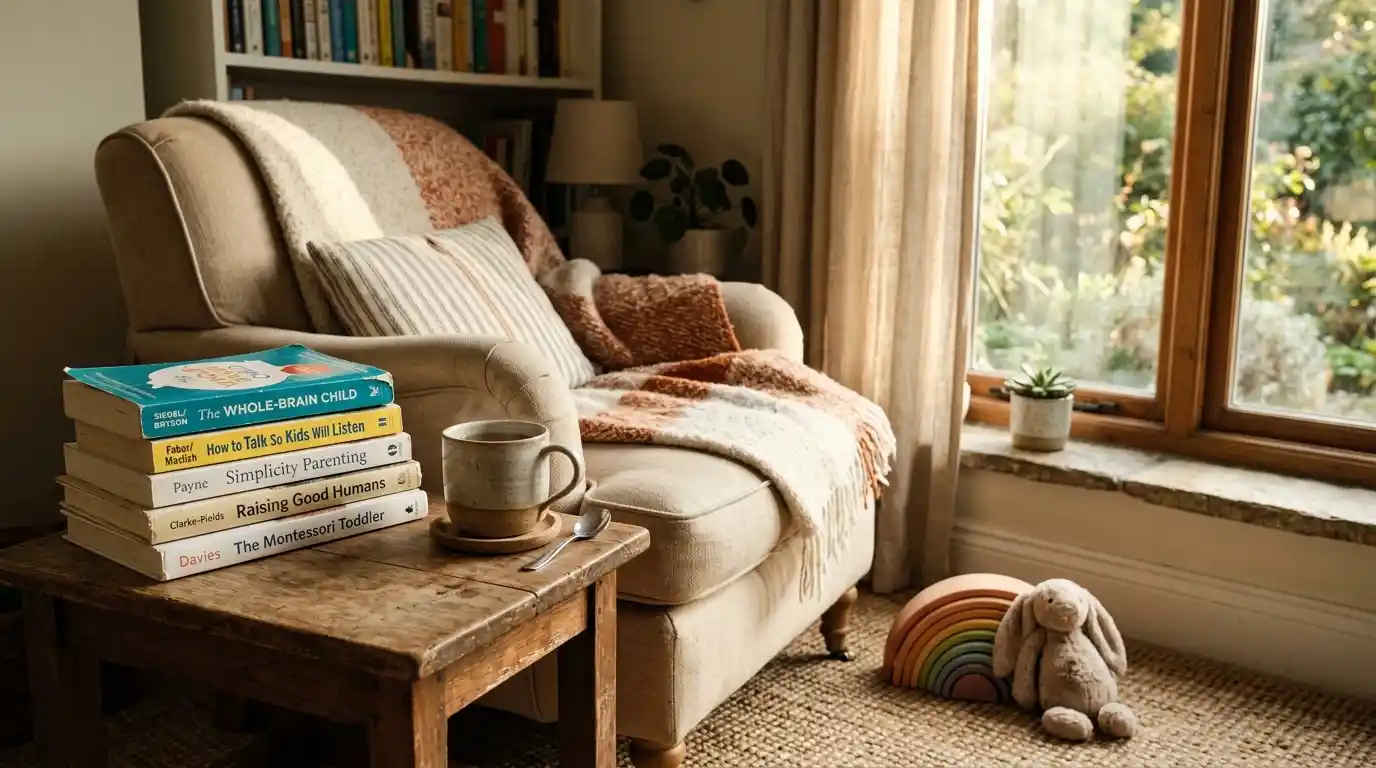
I’ve bought parenting books I never finished. Probably you have too a stack on the nightstand, half-read. Bought during some 2am crisis and abandoned once the crisis passed. Best parenting books get recommended everywhere. But most lists are just Amazon bestseller rankings reshuffled. With no real filter for whether the advice actually holds up against child development research.
This one’s organized differently: by the actual problem you’re facing. With the credentials or research behind each pick stated plainly. So you’re choosing based on your kid’s age and your specific mess, not a generic “top 10” badge.
Picking the Right Book Starts With Being Honest About Your Actual Problem
A brilliant book on newborn sleep is dead weight. If your real issue is a defiant six-year-old refusing to get dressed. Yet people buy the “comprehensive parenting guide” anyway. The one that tries to cover birth through college, and end up with something shallow on everything.
Two filters matter more than star ratings. First: does the author actually have credentials in child development, psychiatry. Or psychology or are they a parenting-content creator repackaging opinion as expertise? Both camps produce useful books, honestly, but knowing which one you’re holding changes how much weight to give it.
Second, and this one gets skipped constantly: age before style. A gentle-parenting book written for toddlers doesn’t transfer cleanly to a fifteen-year-old. The developmental mechanics are completely different animals.
The Newborn Stage Breaks Almost Everyone
Sleep deprivation plus not knowing what a specific cry means that combination wrecks more new parents than anything else in the entire parenting timeline. Two camps exist here: soothing-technique books, and gentler alternatives to cry-it-out.
Harvey Karp’s The Happiest Baby on the Block is the clear pick if you need something practical at 3am, not philosophy. His five-step method swaddle, side/stomach position, shush, swing, suck is built to recreate womb-like conditions, and it’s genuinely mechanical enough to follow half-asleep.
If cry-it-out sleep training makes you uncomfortable, Elizabeth Pantley’s The No-Cry Sleep Solution is the gradual alternative. Slower results, sure. But it’s a real philosophical departure for parents who don’t want a baby crying unsupported, not just a watered-down version of extinction methods.
For the “Why” Behind Behavior, Not Just Scripts
Some parents want to understand what’s happening in a toddler’s brain during a meltdown, not just get a three-step script to survive it. This is where credentialed neuroscience and psychiatry authors actually earn their place.
Daniel J. Siegel and Tina Payne Bryson’s The Whole-Brain Child is the standout. Siegel is a clinical professor of psychiatry this isn’t blog-post science dressed up. The book translates actual brain integration research (the “upstairs/downstairs brain” framing) into something a sleep-deprived parent can apply mid-tantrum.
Meredith Small’s Our Babies, Ourselves comes at it sideways anthropology and biology instead of neuroscience, comparing parenting across cultures to show which Western norms are actually universal versus just cultural habit nobody questioned. Less how-to, more genuinely useful reframe.
What about toddler tantrums specifically?
Siegel and Bryson again, but with The Yes Brain this time same emotional-regulation foundation as Whole-Brain Child, narrower focus on building resilience rather than just managing the meltdown in front of you. Treats tantrums as skill-building, not something to suppress.
And Adele Faber and Elaine Mazlish’s How to Talk So Kids Will Listen & Listen So Kids Will Talk has been the go-to for decades for good reason the communication techniques (reflecting feelings, offering choices instead of commands) genuinely flex from toddlerhood through the teen years with barely any adjustment.
Family Conflict, Sibling Rivalry, General Household Chaos
Every family hits this eventually. The books that handle it well lean on cooperation, not top-down discipline dressed as strategy.
Sura Hart and Victoria Kindle Hodson’s Respectful Parents, Respectful Kids applies nonviolent communication to family dynamics specifically the goal shifts from “winning” an argument to actually resolving it. Barbara Coloroso’s Kids Are Worth It! is related but distinct, built around what she calls “inner discipline” self-regulation the kid actually owns, versus compliance forced from outside.
When You Want Data, Not a Manifesto
Some parents are tired of parenting books that read like someone’s personal philosophy dressed up as fact. Emily Oster’s Cribsheet is the antidote she walks through actual research on breastfeeding, sleep training, screen time, and is unusually honest about where evidence is genuinely thin versus solid. A more balanced approach is to explain what is known, acknowledge the options, and leave the decision to parents rather than telling them exactly what to do.
Teenagers Get Almost No Book Coverage, Which Is Strange
Newborn and toddler advice floods every bookstore shelf. Teen parenting content? Thin. Odd, considering how much harder communication actually gets during adolescence.
Gordon Neufeld’s Hold On to Your Kids tackles peer influence and attachment head-on, arguing that a strong parent-child connection through adolescence matters more than most advice acknowledges especially once peer relationships start competing hard for a teenager’s loyalty.
The Disengaged Teen fills a more specific gap: what happens when a teenager checks out, academically and emotionally, and what a parent can realistically do about it instead of just watching from the sidelines and worrying.
A Quick Word on Bestseller Rankings
Don’t trust Amazon bestseller status alone it reflects sales, not accuracy. Cross-check against Goodreads, and actually read a few critical reviews, not just the five-star ones. A book with strong ratings and an author who holds real clinical or research credentials is a genuinely reasonable combination to trust over marketing copy.
Conclusion
There’s no single “best” parenting book there’s a toolkit, matched to your kid’s age and whatever’s actually breaking in your house right now. Newborn chaos points toward Karp or Pantley. Understanding the “why” behind behavior means Siegel and Bryson. Conflict and cooperation, Hart and Coloroso. And if a teenager’s pulling away, Neufeld’s work on attachment deserves more attention than it usually gets. Pick for this month’s actual problem, not a generic bestseller badge.
FAQs
Probably The Happiest Baby on the Block if you’re deep in newborn sleep chaos, or The Whole-Brain Child once you’re past infancy and into toddler emotional development the right “first” book depends entirely on which stage you’re actually in.
The strongest ones are authors like Daniel Siegel bring actual clinical psychiatry credentials to the neuroscience they cite but it’s worth checking an author’s background before assuming “gentle parenting” on a cover means research-backed.
Gordon Neufeld’s Hold On to Your Kids for the attachment angle, or The Disengaged Teen if the bigger issue is academic and emotional checkout rather than just distance.

2 thoughts on “Best Parenting Books: 12 Titles Worth Actually Reading (Not Just Buying)”