
Here’s the thing nobody selling duct cleaning wants to lead with. The EPA doesn’t actually recommend doing it on a routine schedule. That surprises most homeowners. Since the marketing around air duct cleaning makes it sound like an annual necessity right up there with changing your filter. It isn’t, and knowing the difference matters. Because a proper cleaning runs a few hundred dollars and a bad one can actually stir up more debris than it removes.
This piece walks through the specific conditions that genuinely warrant cleaning your ducts. What a real service actually involves component by component. What it costs, and the questions worth asking before you hire anyone.
Do You Actually Need Air Duct Cleaning?
Short answer: probably not, unless something specific is going on. The EPA’s guidance on this is pretty direct routine duct cleaning isn’t recommended as a preventive measure. And general dust buildup alone isn’t a reason to schedule one. That runs against most of what duct-cleaning marketing implies. And it’s worth knowing before you get talked into an annual contract you don’t need.
There are three conditions where cleaning genuinely makes sense. And they’re specific enough that you can check for them yourself before calling anyone.
What are the three conditions that actually justify duct cleaning?
Visible mold growth on hard surfaces inside the ductwork, confirmed vermin or insect infestation. And debris being discharged into the room from your supply registers are the three situations the EPA flags as legitimate reasons to clean. Notice what’s missing allergies alone, a musty smell you can’t source. Or just general “it’s been a while” aren’t on that list. If you’re dealing with unexplained respiratory symptoms, that’s worth a conversation with a doctor before it’s worth a duct cleaner. Since duct contamination is one possible cause among several.
Should you clean ducts after water damage?
Yes, generally persistent water damage inside ductwork creates the exact moisture conditions mold needs. And that moves it from “maybe someday” into the same category as visible mold. Flex duct and duct board are especially vulnerable here since they can absorb moisture in a way sheet-metal duct doesn’t. And in bad cases replacement makes more sense than cleaning. A contractor should assess your project and recommend the appropriate option rather than automatically providing a standard cleaning quote.
What a Proper Air Duct Cleaning Actually Includes
This is where a lot of companies cut corners, and it’s the single biggest thing to check before hiring anyone. A real, standards-compliant job cleans the whole system not just the visible ductwork you can see through a register.
What parts of the HVAC system should get cleaned?
Supply and return ducts, registers and grilles, the heat exchanger and cooling coil, the drain pan. And the blower motor assembly all need cleaning together, not separately. Cleaning only the ducts while skipping the coils. And blower leaves contamination sitting right where it’ll recontaminate the freshly cleaned ducts within weeks. I’d be cautious about any quote that lists only “duct cleaning” without clearly stating whether the other components are included.
The industry standard here comes from NADCA the National Air Duct Cleaners Association through what’s called the ACR Standard. Most recently updated in its 2025 edition. It spells out source removal, HEPA filtration during the process, and post-cleaning verification as the baseline for a legitimate job. Ask a prospective contractor whether they follow ACR compliance specifically; a real technician will know exactly what you’re asking.
How does the actual cleaning process work?
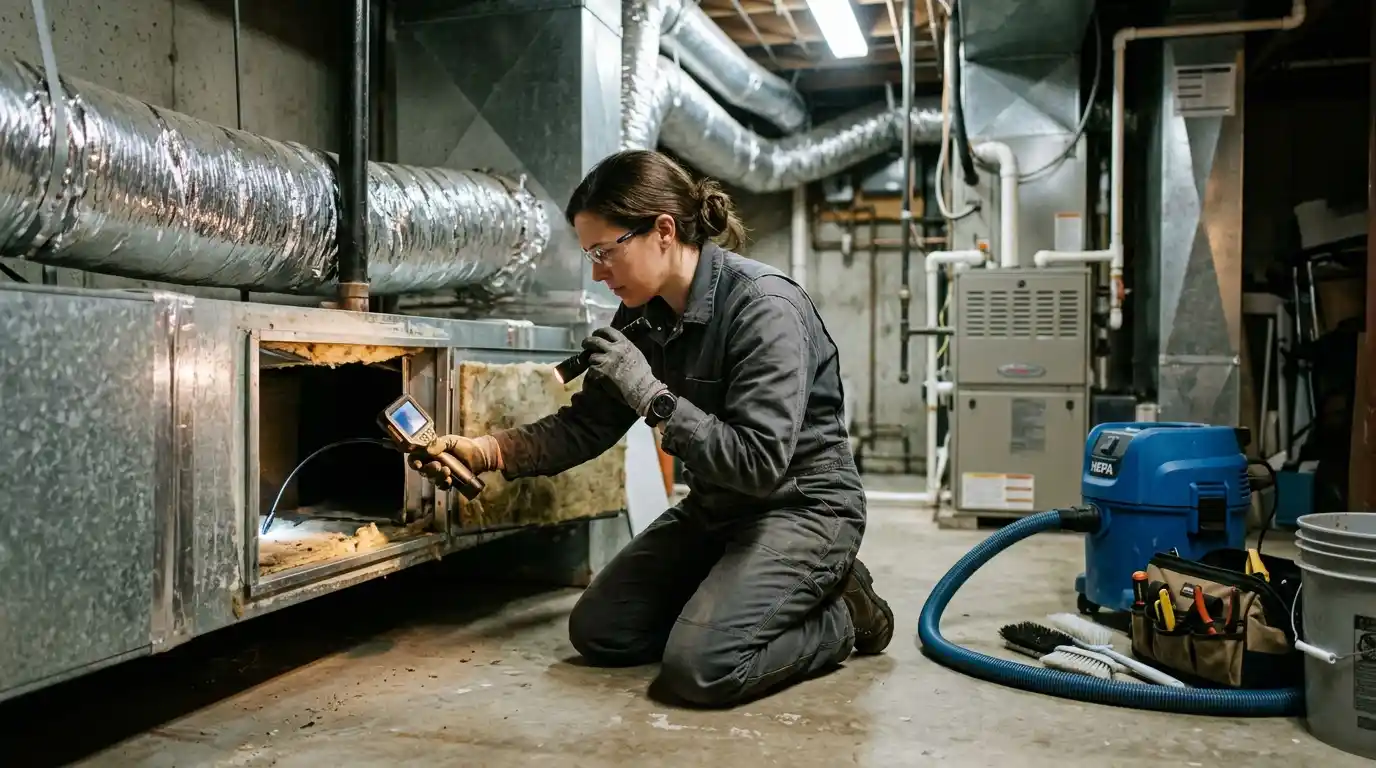
Technicians create negative air pressure inside the ductwork using a vacuum collection system. Then use mechanical agitation brushes. Sometimes compressed air to dislodge debris from duct walls so it gets pulled into the vacuum. Rather than pushed further into the system. HEPA filtration matters because it can capture 99.97% of particles down to 0.3 microns. Helping trap fine dust and mold spores rather than allowing them to circulate back into the air.
Access happens through service openings cut into the ductwork at strategic points. And a competent crew seals those openings back up when they’re done. Ask about this specifically improperly sealed access points create new air leaks. That undercut whatever efficiency gain the cleaning was supposed to deliver.
What Does Air Duct Cleaning Actually Cost?
Pricing varies more than people expect, mostly based on home size, duct accessibility, and how many components actually need attention. National averages hover somewhere in the $269 to $486 range for a typical residential job, with $373 landing as a reasonable midpoint figure though get that verified against current quotes in your specific area, since regional labor costs shift these numbers meaningfully.
Why Do Duct Cleaning Prices Vary So Much Between Companies?
The biggest driver is scope a quote covering the full system (ducts, coils, drain pan, blower) will run higher than one covering ductwork alone, and that’s often exactly the corner-cutting mentioned earlier. An unusually low quote often signals a limited scope of work rather than a genuine bargain.
Home size matters too, obviously, along with how many separate HVAC zones your house has and whether the ductwork is easily accessible or buried behind finished walls and tight crawlspaces. Get at least two quotes and ask each company to itemize exactly what’s included before comparing the bottom-line number.
Choosing a Duct Cleaning Company
Not every company advertising duct cleaning actually follows the ACR standard, and there’s no license requirement in most states preventing someone from calling themselves a duct cleaner with minimal training. This is genuinely a buyer-beware category.
What should you ask a contractor before hiring them?
Ask whether they’re NADCA-certified, whether they follow the current ACR Standard, and whether their process includes cleaning the coils and blower assembly along with the ductwork itself. A company that hesitates or gives a vague answer on any of these is worth passing on, regardless of how competitive their price looks.
Also ask about cleanliness verification a legitimate provider can show you before-and-after evidence, sometimes through a camera inspection, confirming the ducts are actually clean rather than just taking their word for it. This matters more than it sounds; without verification, you’re paying for a process you can’t actually confirm worked.
Air Duct Cleaning for Commercial and Healthcare Buildings
Offices, schools, and healthcare facilities operate under a different set of expectations than a single-family home, largely because occupancy density and specific building-use requirements change the calculus. A hospital’s air-handling units, for instance, typically require inspection at least once a year regardless of visible contamination, which is a stricter standard than most residential guidance calls for.
Do commercial buildings need duct cleaning more often than homes?
Not automatically more often, but the inspection cadence tends to be more structured annual inspections for healthcare air-handling units specifically, with cleaning triggered by the same evidence-based conditions used residentially rather than an arbitrary calendar. Federal buildings even have their own cleaning specification through the Whole Building Design Guide, which gives facility managers a documented standard to point to rather than relying on a contractor’s general recommendation.
Conclusion
Air duct cleaning is worth doing when there’s actual evidence visible mold, confirmed vermin, or debris blowing out of your registers not just because it’s been a while or a postcard showed up in your mailbox. When you do need it, insist on whole-system cleaning covering the coils and blower along with the ducts, confirm ACR compliance, and get verification the job actually worked. Skip it otherwise. The money’s better spent on a good filter and regular HVAC maintenance than on a cleaning your ducts probably don’t need yet.
FAQs
No EPA guidance specifically states that routine duct cleaning isn’t recommended as a preventive measure, and cleaning should instead be triggered by specific evidence like visible mold, vermin, or debris discharge.
Most residential jobs fall somewhere between $269 and $486, with national averages landing around $373, though actual pricing depends heavily on home size and how many system components are included.
Not necessarily duct contamination is only one possible contributor to allergy symptoms, so it’s worth ruling out other causes with a doctor before assuming cleaning alone will solve the problem.

1 thought on “Air Duct Cleaning: 3 Signs You Actually Need It (and When You Don’t)”