
Most backyard advice tells you to “add ambiance” without ever naming a price. Which leaves you guessing whether a project costs $200 or $20,000. This guide skips the vague part. Outdoor living spaces on a budget come down to three decisions. Which surface you build, which few features you splurge on. And where you cut corners without it looking cut. A 150-square foot patio of gravel will cost between $450 to $750 for materials. And can be put together in just one weekend. That is the type of concrete estimate that will enable you to plan. After going through this article, you will know what a $1,000, $1,500, and $2,000 backyard budget will get you.
What Counts as an Outdoor Living Space?
“Outdoor living space” refers to a garden area made for leisure, socializing. And entertainment purposes, beyond simply being able to sit outside on the lawn or cement floor. This can range anywhere from a simple gravel patio with two chairs. All the way to an extensive enclosed area with a kitchen, fireplace. And even lighting! Neither end of this spectrum involves high cost; rather. It is just a matter of layout and amenities that determine. The difference between a cheap and expensive outdoor living space.
Where people go wrong is they try to design the complete loaded setup using an initial budget. The correct way to do it is in sections – the lounge area, dining area. And maybe a grilling bay – all before you purchase anything. This will dictate how you divide up your budget. And it is the only thing that prevents an initial budget design from becoming an assortment of incompatible pieces.
How Much Does It Cost to Create an Outdoor Living Space?
Costs range enormously depending on scope. From a few hundred dollars for a DIY gravel patio to six figures for a complete outdoor room with a kitchen, pool. And permanent structures. Realistically, the point where most people will stand will be within the range of $1,000 to $8,000 which would include pavement of the patio, some nice furniture. And lighting system – amounts that would conform to the standard remodeling costs as per the Cost vs. Value Reports of Remodeling magazine.
Outdoor Living Spaces on a Budget: What $1,000, $1,500, and $2,000 Actually Buys
Determining a number before shopping is by far the biggest determinant for keeping to your budget. So let’s be clear on what each price point will cover. These aren’t marketing estimates — they reflect actual material costs for common DIY builds, checkable against retailer pricing at places like The Home Depot.
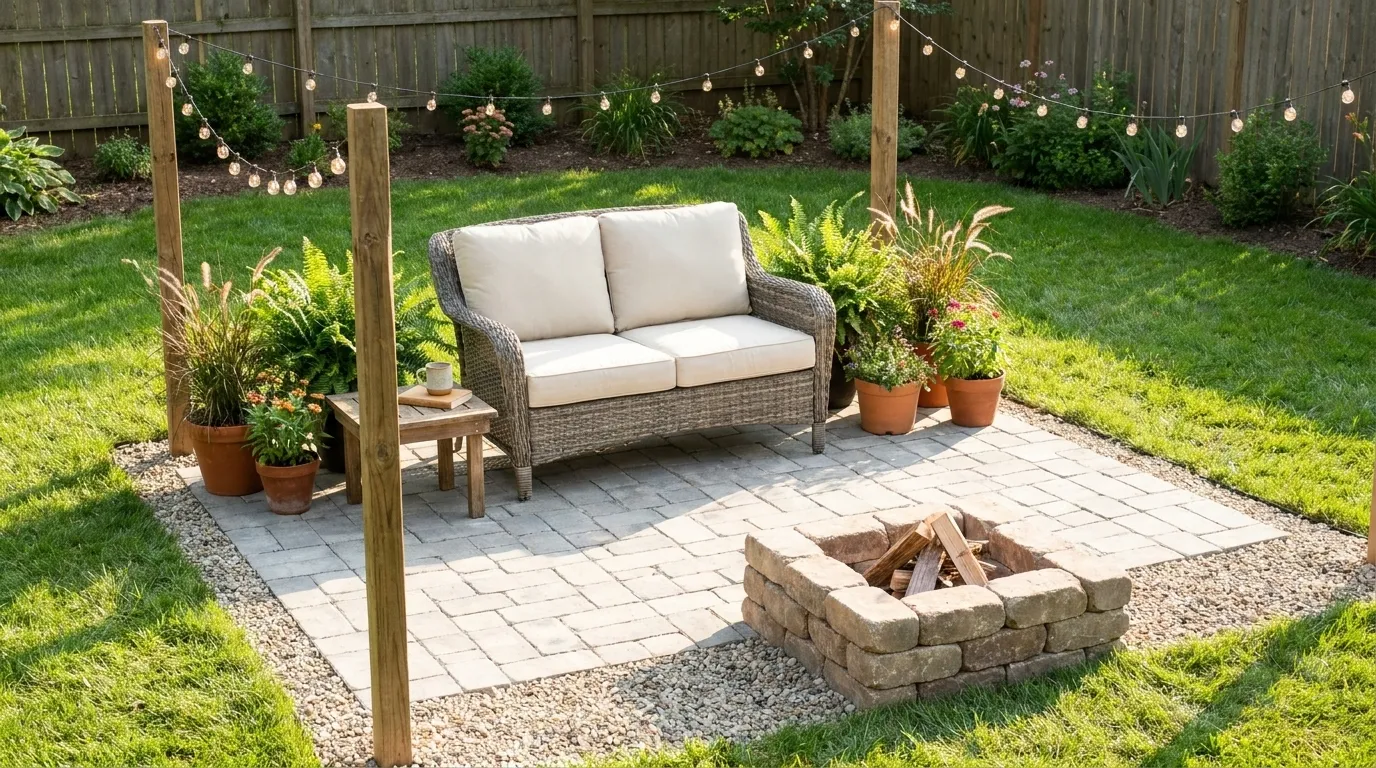
At $1,000, expect a compacted gravel or paver base around 100 to 150 square feet. Two or three pieces of thrifted or repurposed seating. And solar string lights for ambiance without adding to your electric bill. At $1,500, you can stretch that same footprint to include a proper paver border, a small side table. And potted plants at each corner. For $2,000, a patio with 150 to 200 square feet and compacted ground, some good furniture, simple lighting. And plants is truly doable – in my opinion. I would allocate anything from $1,500 to $2,400 to have the full package described above honestly.
What Is a Realistic Budget Split for a Backyard Makeover?
A workable rule of thumb splits your total budget as 40% seating, 20% lighting, 20% plants, and 20% surfaces. This keeps you from overspending on one flashy element — like an expensive fire table. While leaving nothing for the chairs people actually sit in.
Cheapest Ways to Build a Patio Surface
Surface material is usually the single biggest line item. So getting this decision right does more for your budget than any other choice. Skip poured concrete if cost matters — it’s the most expensive common surface and the least forgiving to install yourself.
Gravel is the most affordable option by far: gravel patio that covers 150 square feet will cost $450-$750. While 12 by 12 configuration (144 square feet) costs $150-$430. Concrete pavers are a bit more expensive (about $290-$860 for a 12 by 12 configuration). But they are better suited for areas with heavy traffic. And do not require any additional finishing. Deck tiles are another choice which can be considered if one is renting a house or building on top of a concrete surface. As such tiles need just a flat surface and do not require any digging.
Is Gravel or Pavers Better for a Budget Patio?
Gravel is better in terms of price, but pavers have greater durability and aesthetic value. Hence, which one you choose depends upon your tenure of staying in that place. If you are going to leave the property in a couple of years. Then pavers are the best choice because of the high ROI of 60-80% for paver patios; otherwise. If you intend to stay in the property for some time. Then gravel along with pavers can give you almost 80% of the paver look for less money.
Furniture, Lighting, and Plants That Don’t Look Cheap
Making an inexpensive patio appear expensive has nothing at all to do with the ground. It all depends on what is placed on top of it. This can be done with furniture, lighting and landscaping. Each of which has inexpensive options that photograph well.
When looking to furnish your outdoor space, start by finding second-hand pieces. Thrift stores or online marketplaces will have patio furniture made of wicker or metal at a fraction of the price of their retail counterparts, and adding new cushions will give you a contemporary take on an old design. When considering lighting, go for solar lights, which you can hang Edison-bulb style for an “architecturally-designed” effect for under $50. For plants, potted arrangements at each seating corner do more visual work than a full garden bed. And native species — Louisiana homeowners, for instance. Have easier luck and lower water bills with native plants than imported ornamentals — cost less to maintain long-term.
What Are the Cheapest Backyard Upgrades That Still Look Good?
Three improvements that provide the most bang for your buck are solar lighting. Thrifted furniture with new cushions, and an edged gravel or paver perimeter. They don’t need to be done by a contractor. And usually will not cost you more than $300 for a decently sized patio.
DIY Fire Pits and Water Features on a Budget
Fire pit and water element act as natural points of focus for seating arrangement. Serving as a focal point instead of merely a seating area. Both are much cheaper to make yourself than anyone expects, as long as you keep it on a smaller scale.
A fire pit made out of retaining wall blocks or pavers costs a fraction of what a pre-fabricated one does. Being priced at under $150 in supplies and using only basic tools and a couple of hours of work. Water feature projects using recycled containers or basins with submersible pumps. To add flowing water sounds in a yard will cost less than $100 to build. This is compared to the installation of a professionally-made fire pit area costing. Between $3,000-$8,000 with a 70-80% return on investment according to general remodeling prices – quite handy in helping you decide. Whether you want to do it yourself or hire a contractor, especially because the do-it-yourself option comes at just 5% of the cost.
Outdoor Living Spaces on a Budget vs. Full Contractor Renovations
It’s worth being honest about where DIY budgeting stops making sense, because not every project scales down cleanly. A composite deck, for example, runs $10,000 to $20,000 professionally installed with a 65–75% ROI — numbers that reflect real material and labor costs, not something a weekend DIY budget can replicate at full size. A pergola or covered structure similarly lands between $5,000 and $20,000, and a mid-range outdoor kitchen can run $15,000 to $30,000.
That doesn’t mean budget projects are inferior — it means they’re a different category of project. A $2,000 patio of stone or gravel, with nice furniture and proper lighting, provides real utility every day; a $20,000 composite deck provides both stability and equity in your home, which a cheaper deck just can’t provide. Make your decision according to your time frame and your needs.
Should I DIY My Outdoor Living Space or Hire a Contractor?
DIY will make sense for smaller spaces that are below 200 sq ft, fireplaces, lighting, and furniture because it would be easy and cheap to correct any errors and saving on the cost of labor would be what it’s all about. If the project involves structural decking, wiring for a kitchen, and plumbing for a water fixture, call in an expert.
Conclusion
Creating outdoor living areas without breaking the bank. Is not about searching for some sort of hidden source of cheap materials. But is about arranging how your budget should be spent. Invest in the surface and the seating at first, then use the lighting and the plants as finishing touches, and think of the fire pits and the water features as an optional feature to the center of your project. If you spend $2,000 wisely. You’ll get yourself a legitimate 150 to 200 square foot patio.
FAQs
How much will you have to pay for a small patio to install in your yard?
The cost of materials to build a 12-by-12 patio using gravel will range from $150-$430, whereas building a 12-by-12 patio from concrete pavers will cost you from $290-$860 in terms of materials. If you install the patio yourself during the weekend, labor costs will be almost zero.
What is the most cost-effective way of making a backyard more visually appealing?
The most effective way would be to use solar string lights. Thrift store furniture that can be updated by adding cushions. And a clear boundary of gravel or pavers. This can all be accomplished at less than $300 for any homeowner.
Is DIY patio construction more economical than professional installation?
The cost of DIY is substantially lower, especially for patios smaller than 200 square feet. Where the price is a few hundred dollars compared to $3,000 to $8,000 that a professionally laid paver patio costs. Hiring is better for bigger projects, especially those that involve electricity or plumbing.
How much money do we need to spend on the complete renovation of our backyard?
To renovate our backyard as an attractive backyard area including patios, furniture, lighting. And landscaping, we require a budget ranging from $1,500 to $2,400; however. If the job is extended, it may cost us more than $10,000.